Home › Services
Garage and Shed Demolition Around Katy Without Wrecking the Yard
Small structures cause big headaches when they are past saving. A detached garage with a sagging roof, a rusted metal shed, a carport that leans a little more after every storm, a rotting deck or an old barn on acreage all have to come down eventually, and the hard part is rarely the building itself. It is getting equipment into the backyard, keeping the lawn, sprinklers and driveway intact, deciding what happens to the slab, and making sure any wiring is dead before anyone swings a hammer. What follows explains how a contractor scopes and carries out that kind of teardown across Katy and west Houston, plus the condition your yard ought to be in after the final haul-off. For a local contractor to look it over, email the details.
The kinds of outbuildings that come down here
Behind older houses inside the city, the typical job is a detached one- or two-car garage at the back of the lot, sometimes with a small apartment or storage loft above it, often reached from an alley or a long ribbon driveway. In the newer subdivisions around Katy and Cypress, it is more often a prefabricated storage shed, a backyard gazebo, a pergola or a wood deck that has gone soft. Out toward Fulshear, Brookshire and Waller County, where there is still ranch and farm land, the list grows to pole barns, equipment sheds, horse stalls and metal carports big enough for a tractor.
Wind and water account for many of these calls. A tropical storm peels the roof off a shed or drops a limb through a garage, or a flood leaves a low outbuilding full of mud and rot. Others come down because the owner wants the space back.
Power to the garage has to be dead before work starts
Many detached garages and workshops have electricity, usually fed by a circuit from the main house panel through a buried line or an overhead wire strung across the yard. Before demolition, that feed must be disconnected at the source and the wire made safe, which is work for an electrician, not the demolition operator. If the garage was converted into living space, there may also be water, a drain line and even gas to deal with, and those get shut off and capped the same way they would be on a house.
Buried feeds are easy to forget and easy to hit. A call to Texas811 before anything is dug gets the public lines marked, but private lines running from your own house to the garage are your responsibility to point out, so walk the contractor along the route if you know it.
Permits and approvals for small structures, in general terms
Whether you need a permit to take down a garage or a shed depends on the city, the size of the structure and whether it ever had utilities. Many cities treat a detached garage much like a small house and want a demolition permit, a utility release and sometimes an asbestos survey, since older garages can have asbestos in siding, roofing or floor tile. A small prefabricated shed with no power often needs nothing from the city, but rules vary, so ask before assuming.
If you live under a homeowner association or deed restrictions, the association may have its own say, especially about what replaces the structure, how long the yard can look torn up and where a trailer or roll-off container can sit. In unincorporated parts of the counties, the association is often the stricter reviewer.
Getting equipment into a backyard
Access is the single biggest question on most small-structure jobs. A garage that sits right off an alley or the driveway is easy. A shed in the far corner of a fenced backyard, behind a pool, with a narrow side gate and an air conditioning unit in the way, is not.
- A compact tracked loader or mini excavator can fit through a surprisingly narrow opening and does far less lawn damage than a full-size machine.
- A fence panel is often removed for access and put back afterward, which should be stated in the scope.
- Some owners arrange access through a neighbor's lot or a shared easement; get that permission in writing.
- Where no machine can reach, debris is carried out by hand or wheelbarrow to a trailer at the curb, which adds labor time.
Protecting the lawn, the driveway and what is underground
St. Augustine grass, sprinkler heads and shallow irrigation lines do not hold up well under tracks and tires, especially when the clay is wet. Plywood or composite ground mats spread the weight and keep ruts out of the turf. Mark every sprinkler head and valve box you can find before the work begins, and know where the pool equipment lines and landscape lighting wires run.
Driveways are the other concern. A residential driveway is not built for a loaded dump truck, and the region's expansive soil has often left it with cracks and hollow spots already. A careful contractor keeps heavy trucks at the curb or on the street when possible, loads from the edge and uses a smaller trailer when the drive looks fragile.
Hand demolition, a machine, or both
Small structures are often taken apart by a mix of hand work and machine work. Hand demolition makes sense when the building is close to the house, touches a fence or a neighbor's structure, or holds materials you want to keep, such as old lumber, windows or roofing metal. It is slower but precise.
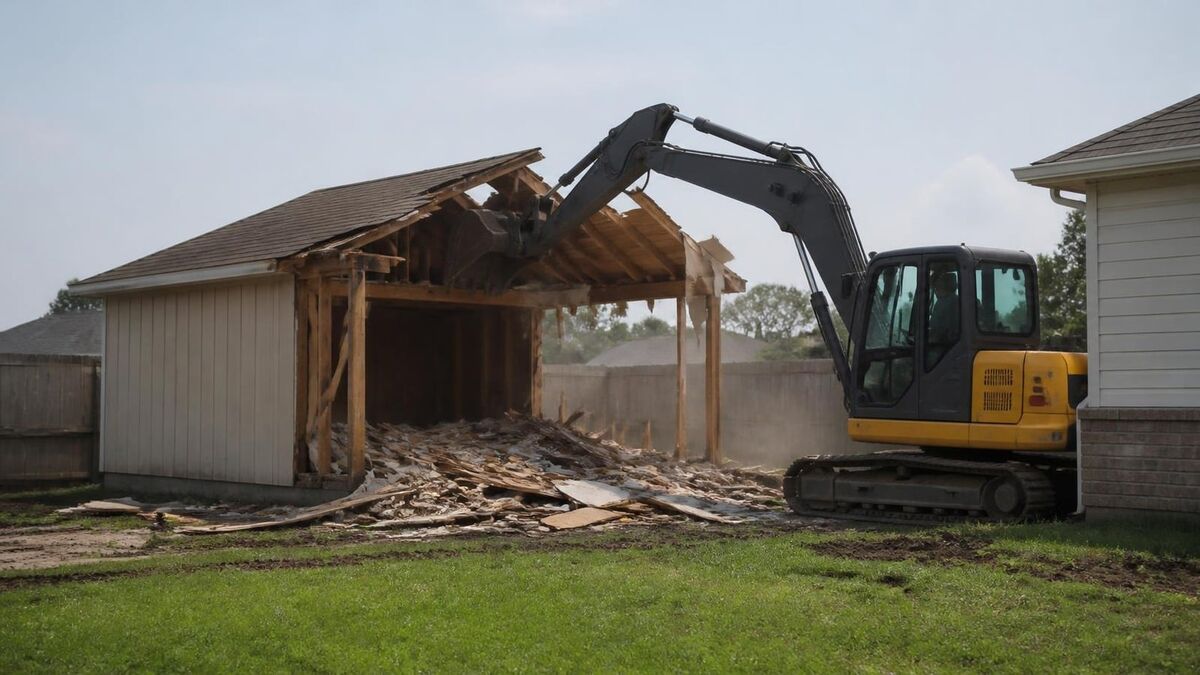
A machine is faster when there is room to work and nothing nearby to protect. The usual approach blends the two: workers remove doors, windows, wiring, gutters and anything salvageable by hand, then a compact excavator pulls the walls and roof inward and loads the debris. On a small lot, the side nearest the house or fence may be taken down by hand while the rest is pulled with the machine.
The garage slab: leave it, reuse it or take it out
Every detached garage sits on something, usually a concrete slab with a thickened edge around the outside, and sometimes on just a few piers or a gravel floor. Deciding what to do with that slab is one of the main choices on the job. Leaving it in place is cheaper and can give you an instant patio, a pad for a new shed or a parking spot for a trailer.
Keeping it only works if the slab is in decent shape. Shifting clay often leaves old garage floors cracked, tilted and stained with oil, and an uneven slab with a raised lip where the walls stood looks worse as a patio than it did as a garage. If you plan to build something new there, your builder may want it removed anyway so a proper foundation can be poured. Breaking out and hauling larger flatwork, such as the driveway that leads to the garage, is covered on the concrete removal page.
Sheds, carports, gazebos and decks
The lighter structures each come apart a little differently, and the details decide how long the job takes:
- Metal sheds are usually unbolted and folded down, and the panels go straight to scrap metal; the anchors or skids underneath are pulled too.
- Wood sheds on skids or blocks are knocked down and loaded, and the blocks are removed so they do not stay hidden in the grass.
- Carports often stand on posts set in concrete footings, which need to be dug out rather than cut off at ground level if the area will be mowed or paved later.
- Gazebos and pergolas come apart quickly but may have footings, electrical for fans or lights, and a concrete pad of their own.
- Decks attached to the house need a careful hand where the ledger board meets the wall, so siding, brick and flashing are not damaged, and then the posts and footings are pulled.
Old barns and outbuildings on acreage
Rural lots west of Katy and around Fulshear bring their own complications. Barns and sheds there were often added to over decades, so one structure can include treated poles set deep in the ground, salvaged tin, old concrete, and a lean-to bolted on years later. Expect leftover junk inside: rusted equipment parts, old fencing wire, feed sacks, tires and containers of unknown chemicals. Those need to be identified and handled separately before the structure itself comes down.
Access is usually easier on acreage, but distance is a cost. A long haul from the back pasture to the road and then on to a recycling yard or landfill adds up. Say up front if you want to keep tin panels or solid timbers.
Hauling and where the debris ends up
Even a modest garage fills a trailer or two. Debris is generally separated as it comes down: metal roofing, steel framing and aluminum go to a scrap yard, broken concrete is often hauled to a crusher where it can be recycled, and wood, shingles, drywall and the rest go to a landfill or a transfer station. Treated lumber from decks and fence posts belongs in the landfill pile; it should never be burned on site.
The contractor may haul with a dump trailer at the curb or use a roll-off container dropped in the driveway, depending on volume and access.
What the yard looks like afterward, and what affects the price
When the work is done, the footprint of the old structure should be clear of nails, screws, glass, roofing scraps and concrete pieces. A magnetic sweeper should go over it for stray hardware. If the slab came out, the area is filled with soil, leveled to match the surrounding grade and left ready for sod, seed or the next project, though the grass itself is usually up to you. A clear, smooth patch with no low spots is the goal, so rain drains away from the house instead of toward it.
The cost of a small-structure teardown depends mainly on the size of the building, how it was built, whether the slab is removed, how hard the backyard is to reach, whether power or plumbing must be made safe first, any asbestos found in older materials and how far the debris travels. If a whole house is coming down as well, see house demolition, and if a backyard pool is going too, see pool removal.
Garage and Shed Demolition Around Katy Without Wrecking the Yard — common questions
Do I need a permit to tear down a shed in my backyard?
Sometimes, and it depends on where you live and what the shed is. A small prefabricated storage shed with no electricity often needs no city permit at all, while a larger building, a garage or anything that ever had power or plumbing is more likely to need one. Check with your city or county permit office, and also check with your homeowner association if you have one, because they may require their own approval even when the city does not.
Can a detached garage be torn down without damaging my driveway?
Usually yes, if the contractor plans for it. The main risk comes from heavy loaded trucks parking on a driveway that was poured for cars. Keeping the truck at the curb, using a smaller trailer, laying mats and loading from the edge all reduce that risk. Photograph existing cracks before work starts.
Should I keep my old garage slab and turn it into a patio?
It can work if the concrete is fairly level, not badly cracked and not heaved by the clay underneath. Many old garage floors have a raised edge where the walls sat, oil stains and a slope toward the old door, which can make an awkward patio. Have the contractor look at it once the walls are off, when the full slab is visible, before you decide. Removing it later costs more than taking it out during the same job.
Who shuts off the electricity to a detached garage before it is torn down?
A qualified electrician should disconnect the garage circuit at your main panel or subpanel, remove or cut back the wiring and make the ends safe. If power to the garage comes straight from the utility on its own meter, the electric provider has to pull that meter. The demolition contractor should not be guessing about live wiring.
Will my HOA let me remove a carport or shed?
Most associations allow removal, but many require you to submit a request before any exterior change, including taking something away. They may care about how long the work takes, where a trailer or container sits, what goes in its place and whether a fence panel is removed for access. Read your deed restrictions and get written approval before scheduling the work, since an association can send violation notices if it was not consulted.
Can I take down part of my shed myself and just pay to have it hauled?
Some owners do the light work themselves, like emptying the shed and pulling off doors or trim, and then have a contractor handle the structure and the hauling. That can save labor, but be careful with roofs, overhead wiring and anything that might contain asbestos. Tell the contractor exactly what you plan to do so the scope and pricing reflect it, and leave the heavier structural parts to people with the right tools.
What is left after an old barn is torn down on rural property?
A good job leaves bare ground with the posts, footings and any concrete floor removed, unless you asked to keep the pad. Scrap metal is hauled away, wood is disposed of and nails are swept from the area. If the barn sat for decades, expect the soil underneath to be uneven and possibly darker or packed down, so it may need fill and leveling before you plant grass or build something new there.
Talk through your site
Start with the address, what needs to come down, and a few photographs of the structure and the access to it.
Related work
House Demolition
Full teardown of a house down to a clean lot, with the slab or pier foundation broken out and utilities handled first.
Pool Removal
Gunite, fiberglass and vinyl pools broken out or filled in, with fill placed and compacted so the yard is usable again.
Interior Demolition
Kitchen, bath and flood-damaged room gut-outs down to the studs, protecting what stays and hauling what goes.
Concrete Removal
Cracked driveways, patios, walks and slabs broken up and hauled off, with the base left ready for what comes next.
Across the metro
Houston
The city itself: older pier-and-beam bungalows, deed-restricted neighborhoods and teardown-and-rebuild lots.
Cypress
Northwest suburb with master-planned subdivisions, slab houses, backyard pools and creekside floodplain.
Fulshear
Fast-growing western community with big new lots, ranch acreage, barns and association design rules.
Sugar Land
Southwest suburb with established subdivisions, aging pools, patios and long concrete driveways.