Home › Services
Concrete removal in Katy for cracked driveways, patios, walks and slabs
Concrete around a Katy house rarely dies of old age. It splits because the clay under it swells after a wet spring and shrinks back during a dry August, because a tree root lifted one panel, or because water ran under an edge for years and carried the sand away. Once a driveway or patio is tilted, trip-prone and holding puddles, patching only buys time. Below is the practical sequence for getting flatwork out: choosing saw lines, matching a breaker to the slab, why depth and rebar change everything, where the broken pieces end up, and the finished grade you should expect once the final haul is gone. It applies across Katy and the rest of the west Houston area; send the address and a few photos and we'll take a look.
Why concrete fails on west Houston clay
The soil across Katy and the rest of the west side is mostly expansive clay. In a dry stretch it pulls away from the bottom of a slab and leaves hollow spots; after heavy rain it swells and pushes back up. A driveway on that ground moves every season until the movement opens a crack. Flat lots make it worse, because water sits against the edges and softens the clay right where the concrete needs support.
Roots are the second big cause; a thick oak root can raise one panel well above the next. The third is a weak base, often a thin layer of sand over raw clay that has washed out through the joints over the years. When a slab is cracked into several pieces, has sunk or lifted at the joints, or slopes water back toward the garage, removal and a fresh pour usually make more sense than another round of patching.
What concrete removal usually covers
Most calls are about flatwork, though the same equipment handles more. Common pieces include:
- Driveways, from a short two-car pad to a long run back to a detached garage, along with the approach where it meets the street
- Back patios and the slab under an old covered porch or pergola
- Front walks, side walks along the house and the paths that lead to a gate
- Stand-alone slabs: an old shed pad, a basketball court, a dog run, a slab left behind by a carport or an equipment pad
- Front steps, stoops and small landings poured against the house
- Footings and piers buried in the yard from old posts, clotheslines, carports or play sets
- Curbing and mow strips around beds that have cracked and shifted
Thickness and steel decide most of the effort
Two slabs that look alike from above can take very different amounts of work. A thin, unreinforced walkway breaks into manageable chunks with a few passes of a breaker. A thick driveway with turned-down edges and a tight grid of rebar fights back the whole way. The contractor learns what is inside from a broken edge, a small test cut, or knowing how that subdivision was built.
Reinforcement comes in a few forms. Welded wire mesh is a flat grid of light wire that holds cracked pieces together; it is easy to cut but tangles in the rubble. Rebar is heavier bar that has to be sheared or torched where the slab is broken. Some newer flatwork uses fibers mixed into the concrete, which adds toughness without any steel to separate. Each one changes how the pieces break and where they can go afterward.
Saw cutting a clean edge for partial removal
Not every job means taking all of it. Often only the panels near the garage have sunk, or a patio extension needs to come out while the original slab stays. In that case the line between keep and remove is cut first with a concrete saw. A full-depth saw cut gives a straight, square edge for the new pour to butt against, and it stops the breaking from spreading cracks into concrete that was supposed to survive.
Saw cutting is wet, loud work; water cools the blade and holds down silica dust. Where new concrete will tie into old, the person pouring may want steel dowels drilled into the cut face. Where a driveway meets a public sidewalk or the street, the cut is often set at an existing joint, since the city may have a say about the approach.
How the breaking is done
The method depends on the amount, the thickness and how close the slab sits to the house or a neighbor. A typical removal runs like this:
- Locate what is buried. A call to Texas811 gets the public utility lines marked; private lines such as sprinkler pipe, landscape lighting, a gas line to a grill or a buried feed to a detached building are found by asking the owner and looking around.
- Cut the edges that have to stay clean, including any line along the house, the garage slab or a section that is being kept.
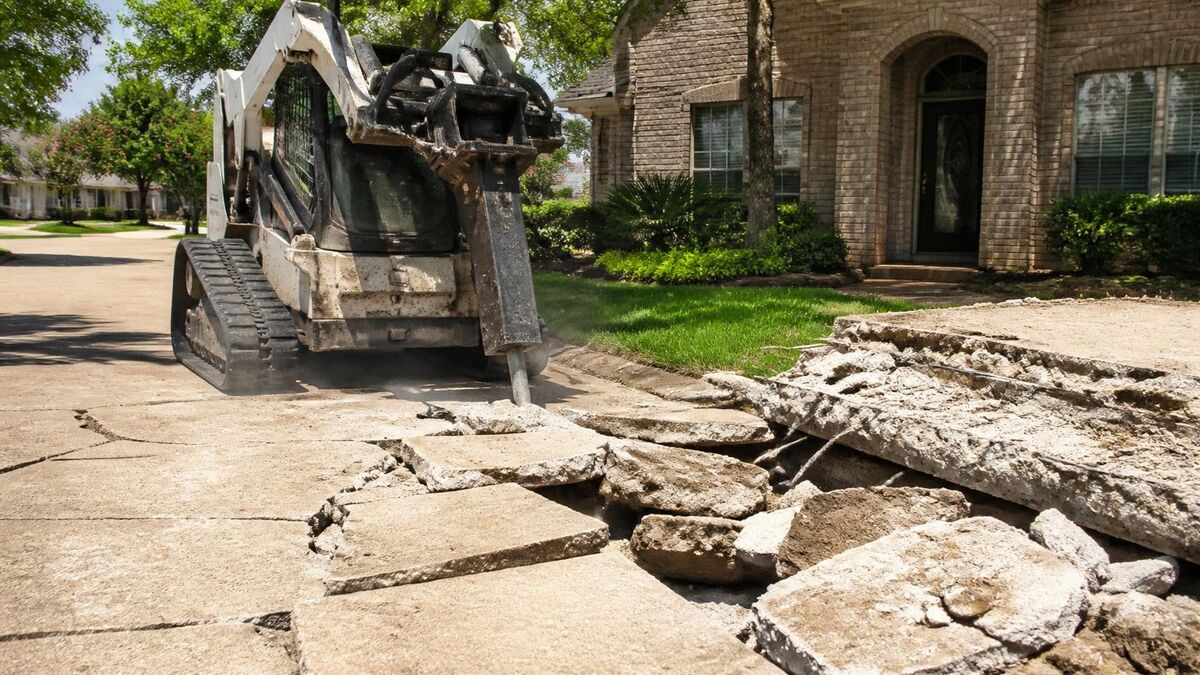
- Break the slab. Small or tight jobs get a handheld breaker or jackhammer. Larger areas get a hydraulic breaker mounted on a skid steer or a mini excavator, which shatters the concrete in a grid pattern into pieces a machine can lift.
- Pry and lift. A bucket or grapple works under the broken pieces and lifts them free, with workers cutting mesh or rebar where it still ties pieces together.
- Load out. Rubble goes into a dump truck or a roll-off container parked where it will not crush the lawn or block the street longer than needed.
- Clean up the subgrade, rake out leftover fragments and leave the ground in the condition agreed on in the proposal.
Protecting the house, the yard and everything that stays
The riskiest edge on any removal is the one against the house. Driveways and patios often butt right up to the foundation or the brick ledge, and hammering hard at that joint can chip the slab edge or crack brick. A careful contractor saw cuts that line, breaks the last strip by hand or with a light breaker, and leaves the foundation face alone. The same care applies at the garage door, where the driveway meets the garage slab.
Out in the yard, loaded trucks and track machines rut wet clay fast, so the haul path is planned before anything breaks and mats go down on soft days. Sprinkler pipe near the slab edge almost always takes some damage and is worth discussing up front. If a valued tree has roots under the driveway, an arborist's opinion before work starts is cheap compared with losing it. Chips can fly a surprising distance, so windows and parked cars get covered too.
Steps, stoops and buried footings
Front steps and stoops look minor but often take more thought than a large patio. They are poured against the house, sometimes filled with rubble and sometimes pinned to the foundation with steel, so they have to be separated without harming the slab edge, the brick or the threshold.
Footings are the hidden half of the job. An old carport, a pergola, a swing set or a long-gone mailbox may have left a block of concrete well below the grass. These come out with a mini excavator or by hand, and the hole is filled and tamped so it does not settle into a soft spot later. If a larger structure is coming down with its slab, such as a detached garage or shed, that work is covered on the garage and shed demolition page.
Where the broken concrete goes
Clean concrete is one of the easiest demolition materials to recycle. Around the Houston area, crushing yards take broken slabs, run them through a crusher, pull out the steel with magnets, and sell the result as crushed concrete base for roads, pads and driveways. Rebar and mesh that come out on site are bundled and sent to a scrap metal buyer. Rubble that is mixed with dirt, wood, asphalt or trash is harder to place and may have to go to a landfill or transfer station instead.
So sorting matters even on a small job. Weight matters too: a truck hauling broken slab fills by weight long before it fills by volume, and the number of loads is one of the clearest drivers of the final price.
The base under the slab
Once the concrete is gone, the ground underneath shows why it failed: a sand cushion washed into voids, wet gray clay that pumps under foot, spreading roots, an old layer of gravel or shell, and now and then an earlier slab buried beneath the one just removed.
For a new driveway, the replacement contractor usually wants soft material dug out, the subgrade shaped to drain away from the house, and fresh base placed and compacted. For a yard going back to grass, topsoil and a level grade are what count. Settle who does this preparation before work begins; a blurry line here is how an owner ends up with an open dirt patch and nobody scheduled to finish it.
Getting ready for the new driveway or patio
Removal and replacement work best as one plan, even when two different companies do them. Bare clay left open during a week of summer thunderstorms turns to mud, softens and has to be dried or dug out again before anyone can pour. Coordinating dates so the forms go in soon after the old slab comes out protects the base and keeps the lot usable.
Homeowner associations in many Katy subdivisions have rules about driveway width, finish and color, and some want plans approved first. Settle any new layout before demolition so the cuts land in the right place. If an old pool and its deck are part of the picture, see the pool removal page.
Cost drivers and what a solid proposal spells out
Every concrete job is priced after the contractor sees it, because the numbers that matter cannot be read from a photo. The things that move the price most are:
- Total area and thickness, which together set how much material has to be broken and hauled
- Reinforcement: no steel, wire mesh, rebar or fibers, and how densely it was placed
- Access for equipment, including gate width, side-yard clearance, overhead lines and how far the haul path runs
- How much of the edge sits against the house, the garage or concrete that is staying, and how much saw cutting that requires
- Disposal: whether the rubble is clean enough to go to a crushing yard and how many truckloads it makes
- Base work after removal, such as digging out soft clay, grading and placing new base
- Repairs to sprinklers, sod and anything else the removal disturbs, and whether those are included
Concrete removal in Katy for cracked driveways — common questions
Should I replace my cracked driveway or just repair it?
Hairline cracks and a few small chips can usually be sealed or patched. Removal starts to make sense when panels have sunk or lifted so joints no longer line up, when water collects against the garage or the house, when large pieces rock under a car, or when the surface is breaking apart across most of its area. On clay soil, a slab that has already shifted often keeps shifting, so a patch on top of a moving panel tends to crack again within a season or two.
Can just part of a concrete driveway be removed?
Yes. Partial removal is common when only the panels nearest the garage or the street have failed. The contractor saw cuts along a joint or a straight line, breaks out the damaged section, and leaves a square edge for the new concrete to meet. The new section will not match the old color exactly, and some owners decide to replace the whole run for that reason. Ask whether the person doing the new pour wants dowels drilled into the cut edge to tie the two together.
Does rebar in a patio make it harder to remove?
It adds work but rarely stops anything. Rebar holds broken pieces together, so after the slab is broken the steel has to be cut with shears, a saw or a torch before the chunks can be lifted. Heavy rebar in a thick slab can noticeably lengthen a job compared with plain concrete. The upside is that clean steel separated on site goes to a scrap buyer instead of a landfill, and the concrete left behind is easier to recycle.
What happens to concrete after it is torn out?
Clean concrete usually goes to a crushing yard, where it is broken down into gravel-sized pieces, stripped of steel and sold as base material for new roads, pads and driveways. Steel pulled out on site goes for scrap. Concrete mixed heavily with soil, roots, wood or trash is harder to recycle and may need to go to a landfill or transfer station. Keeping the rubble clean during removal is one of the simplest ways to keep disposal reasonable.
Is city approval required to remove a driveway in Katy?
It depends on where the property sits and how far the work reaches. Breaking out a backyard patio on private land often needs nothing from the city, while work on a driveway approach, a curb cut or a public sidewalk inside city limits commonly does. On unincorporated land, the county, your MUD and your HOA can each layer on conditions too. The contractor should confirm the current requirements for your address before scheduling, and HOA approval is worth getting in writing.
Can removing a patio damage my house foundation?
It can if the work is careless, which is why the joint against the house gets special handling. A good contractor saw cuts the patio free of the foundation, breaks the last strip near the house with light tools, and avoids pounding against the slab edge or the brick. Removing the patio can also change drainage next to the house, so plan the new grade or new pour to carry water away from the foundation instead of letting it pool there.
Talk through your site
Start with the address, what needs to come down, and a few photographs of the structure and the access to it.
Related work
House Demolition
Full teardown of a house down to a clean lot, with the slab or pier foundation broken out and utilities handled first.
Garage and Shed Demolition
Detached garages, carports, sheds, barns and decks taken down and hauled off without tearing up the yard.
Pool Removal
Gunite, fiberglass and vinyl pools broken out or filled in, with fill placed and compacted so the yard is usable again.
Interior Demolition
Kitchen, bath and flood-damaged room gut-outs down to the studs, protecting what stays and hauling what goes.
Across the metro
Houston
The city itself: older pier-and-beam bungalows, deed-restricted neighborhoods and teardown-and-rebuild lots.
Cypress
Northwest suburb with master-planned subdivisions, slab houses, backyard pools and creekside floodplain.
Fulshear
Fast-growing western community with big new lots, ranch acreage, barns and association design rules.
Sugar Land
Southwest suburb with established subdivisions, aging pools, patios and long concrete driveways.